Sleeping in separate bedrooms: a bad sign in your 40s?
One of you snores, one of you reads till one, one of you is up at five. Sleeping apart is more common than people admit, especially at this age. Here's what the surveys and research say, and how to suggest it without it sounding like a breakup.
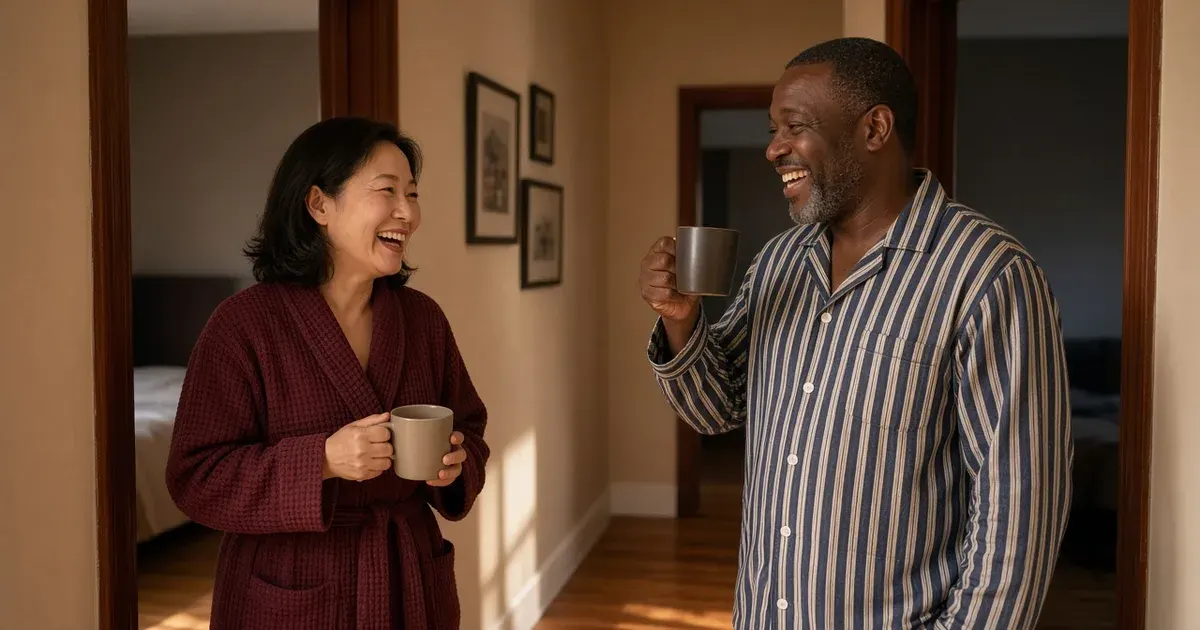
Sleeping in separate bedrooms isn’t automatically a bad sign. Plenty of couples do it, and people in their late 30s and early 40s are among the most likely to. What matters is why you’re doing it and whether you both agreed. When a “sleep divorce” is a joint fix for snoring or clashing schedules, it can protect the relationship. When one partner simply moves out of the bedroom, it can feel like a different kind of divorce.
It’s more common than you’d guess
In a 2025 survey by the American Academy of Sleep Medicine, 31% of U.S. adults said they sometimes or always sleep in another bed or room to accommodate a partner. Among 35- to 44-year-olds the figure was 39%, compared with 18% of people 65 and older.1 That’s a survey of habits, not of happiness. It doesn’t tell us whether those couples are better or worse off.
The survey doesn’t say why that age group stands out. Kids waking at night and work schedules are plausible guesses, but they’re guesses.
What the research on couples and sleep says
A 2007 review led by Wendy Troxel found that most adults share a bed with a partner. It also found that sleep and relationship quality seem to affect each other in both directions. Bad nights can make for a worse relationship, and a strained relationship can make for worse nights.3
A 2025 review in the Journal of Health Psychology took a balanced line. Sharing a bed can support intimacy, but sleep disorders can make it hard to manage. Sleeping apart is one reasonable strategy, and nobody yet knows its long-term effects on relationships.4
So there’s no research verdict that separate rooms help or harm. There’s a fairly consistent finding that poor sleep is bad for couples.
The snoring caveat
If snoring is the reason, don’t stop at a new room. The AASM notes that loud snoring may be a sign of obstructive sleep apnea, which should be evaluated by a clinician.1 The Associated Press profiled one couple, together 42 years, who began sleeping apart because of the husband’s snoring and apnea. It worked for them, and it came with a diagnosis, not instead of one.5
How to suggest it without it sounding like rejection
Psychiatrist Stephanie Collier told Harvard Health that the relationship could suffer if one partner doesn’t want to sleep apart. She suggests a heart-to-heart before anyone moves, and trying compromises like earplugs first.2 Some practical steps:
- Frame it around sleep, not each other. “I want us both rested” lands differently than “I can’t sleep next to you.”
- Try it part-time. A few weeknights apart and weekends together is one middle ground.
- Protect the in-between. Keep a bedtime chat, a morning coffee, or ten minutes in the same bed before one of you moves.
- Agree to check in. After a month, ask each other honestly how it’s going.
If you’re newly together and it feels too early to raise, our piece on how to set boundaries in your 40s covers asking for what you need early on. If the question is really whether you still feel close at all, why a partner can seem distant is a better starting point.
The gaps in what we know
- The AASM figures describe habits. They don’t measure whether couples who sleep apart are happier.
- No long-term studies. The 2025 review notes that the long-term effect of sleeping apart on relationships is unknown.4
- One couple’s story isn’t data. The AP profile shows it can work. It doesn’t show how often it does.
Try it
What's really behind the separate-rooms question for you?
Steal this text
Say it in your own words, or start from these
Suggesting it kindly
I love falling asleep next to you, and I'm also wrecked every morning. Could we try separate rooms a couple of nights a week and see how we both feel?
Keeping the closeness
If we do this, I don't want to lose our bedtime. Can we keep our chat in bed before I head to the other room?
People who talk about this
- Credentialed source
Eli J. Finkel
Research on how modern marriage and long term relationships work, and what partners expect from each other.
- Credentialed source
- Trending voice
Julie Menanno
How couples get stuck in conflict cycles and how to feel secure with a partner.
- Credentialed source
Justin J. Lehmiller
Research on sex, desire, casual relationships and friends with benefits.
- Credentialed source
Lori Gottlieb
What happens in the therapy room, including breakups, dating choices and the stories people tell about love.
Further reading
Pew Research Center, 2020
Dating and relationships: Key findings on views and experiences in the US (opens pewresearch.org)National survey data on how American adults feel about dating today, including why many say it has gotten harder.
The Gottman Institute
How to Stop Detached Dating and Create Real Connection (opens gottman.com)Explains why dating can feel guarded and transactional, and how to show up with more openness.
Sources
- New survey data reveals nearly one-third of Americans engage in a ‘sleep divorce’
- Tips to navigate a 'sleep divorce'
- Marital quality and the marital bed: Examining the covariation between relationship quality and sleep
- Interactions between co-sleeping, sleep quality, and relationship health: The benefits and challenges of shared sleep environments
- Specialists say there are benefits to couples sleeping separately