How to make couple friends in your 40s (and why bother)
You're past the early dates and into the part where you'd like a life together, which usually means other people in it. Making friends as a pair is its own skill. A handful of lab studies show what speeds it up, and a bonus most people don't expect.
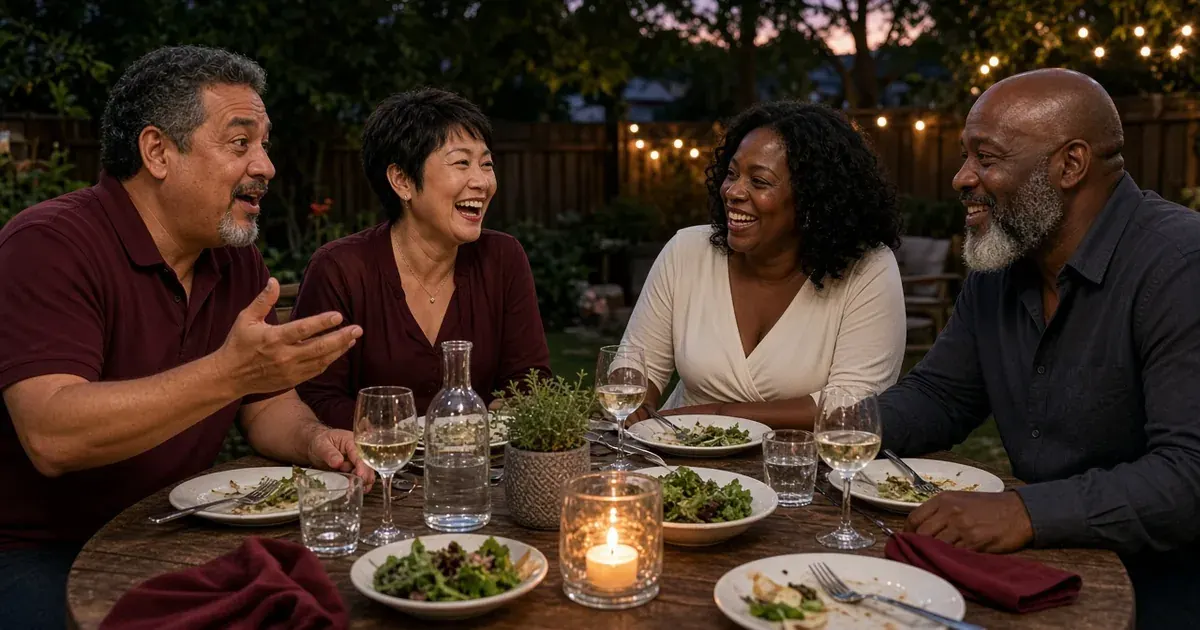
Making couple friends works best when you skip past small talk sooner than feels natural. In a lab study of 60 couples, pairs who took turns answering personal questions with another couple for 45 minutes felt closer to them than pairs who just made conversation. They were also more likely to meet up again in the following month, and they felt closer to their own partners.1
Why is it harder to make friends as a couple?
Partly it’s timing. In national data from the Netherlands, people’s friendship networks shrank mainly at two points: when they started dating and when they married or moved in together.4 After those transitions, networks kept getting smaller with age.4
The same data showed that the share of friends partners have in common rises the longer they’re together.4 Shared friends tend to build up over time. In a newer relationship, you’re near the start of that.
What makes two couples click?
Disclosure, mostly. The approach behind the couples study comes from earlier research that set up 45 minutes of escalating self-disclosure tasks between strangers. Pairs doing those tasks felt closer than pairs doing small talk.3 What didn’t matter as much was how well-matched the pair seemed: pairing people who agreed on important attitudes, or telling them they’d probably like each other, made no significant difference.3
When the same idea was applied to two couples at once, the high-disclosure pairs felt closer to the other couple and were more likely to see them again.1
Can couple friends make your own relationship better?
That’s the bonus. In the original couples study, the pairs who opened up to another couple also felt closer to each other afterward, and the effect ran through a lift in positive mood.1
A follow-up went further. Couples who did high-closeness tasks with another couple showed bigger increases in passionate love toward their own partner than couples who did similar tasks alone. What carried the effect was how responsive the other couple was.2 The researchers suggest couple friendships as another way to rekindle passion.2
How do you get from one dinner to real friends?
The studies only measured the first steps. Here’s what they suggest:
- Pick one couple, not a crowd. The effects came from one-on-one couple pairings.1
- Ask better questions earlier. Personal questions, taken in turns, beat polite catch-up.13
- Be responsive. The other couple’s responsiveness is what lifted passion in the follow-up, so your interest in them matters as much as what you share.2
- Suggest the next one soon. The high-disclosure couples were the ones more likely to get together again within a month.1
Quick recap
- Self-disclosure beat small talk for making couples feel close.1
- Friend networks shrink when people start dating and move in together.4
- Being well-matched mattered less than the conversation itself.3
- Opening up to another couple was linked to more passion at home.2
If one of you is the one without much of a social circle, when a partner has no friends looks at what that does and doesn’t signal. For the rhythm of a newer relationship in general, there’s how often to see each other in your 40s.
Try it
What's the snag for the two of you?
Steal this text
Say it in your own words, or start from these
The low-key invite
We've been meaning to have people over and you two came to mind first. Dinner at ours on Saturday? Nothing fancy.
After a good first evening
That was the best night we've had in a while. Same time next month? Your turn to pick the place.
To your own partner, afterward
I liked seeing you with them tonight. You were funny. Want to ask them over again?
People who talk about this
- Credentialed source
Eli J. Finkel
Research on how modern marriage and long term relationships work, and what partners expect from each other.
- Credentialed source
- Trending voice
Julie Menanno
How couples get stuck in conflict cycles and how to feel secure with a partner.
- Credentialed source
Justin J. Lehmiller
Research on sex, desire, casual relationships and friends with benefits.
- Credentialed source
Lori Gottlieb
What happens in the therapy room, including breakups, dating choices and the stories people tell about love.
Further reading
Pew Research Center, 2020
Dating and relationships: Key findings on views and experiences in the US (opens pewresearch.org)National survey data on how American adults feel about dating today, including why many say it has gotten harder.
The Gottman Institute
How to Stop Detached Dating and Create Real Connection (opens gottman.com)Explains why dating can feel guarded and transactional, and how to show up with more openness.
Sources
- When Harry and Sally met Dick and Jane: Creating closeness between couples
- Effects of self-disclosure and responsiveness between couples on passionate love within couples
- The Experimental Generation of Interpersonal Closeness: A Procedure and Some Preliminary Findings
- Shared friendship networks and the life course: an analysis of survey data on married and cohabiting couples